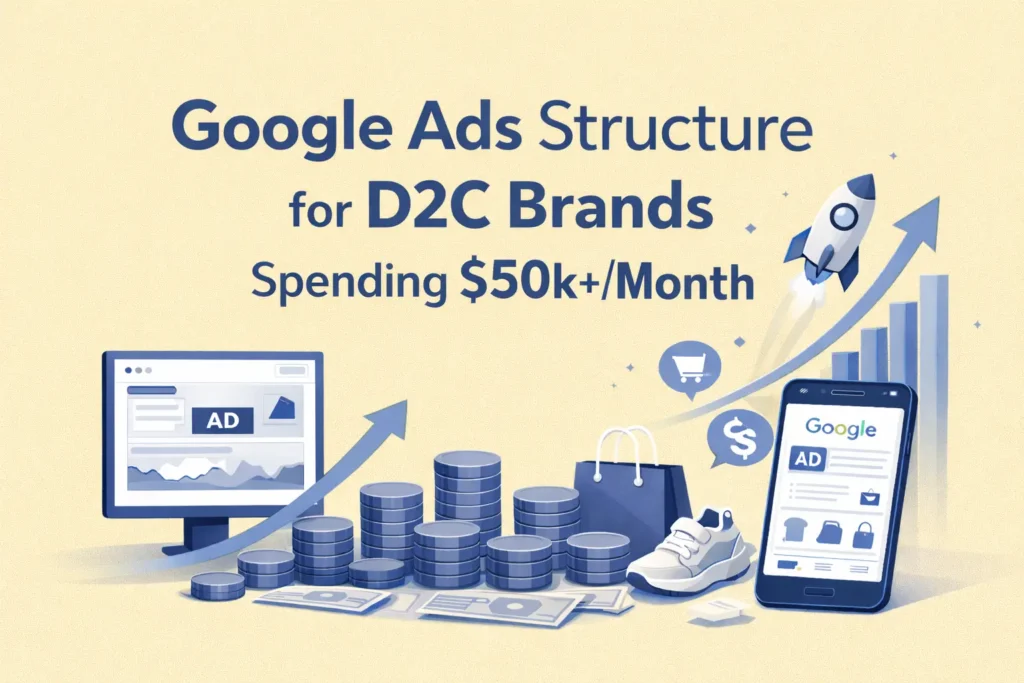
Once a D2C brand crosses $50k per month in ad spend, Google Ads stops being about “running campaigns” and starts being about structure. At this level, messy accounts, overlapping campaigns, and unclear data can quietly kill profitability.
This guide explains a clean, scalable Google Ads structure for D2C brands spending $50k+ per month – written in plain language, without over-complication.
Why Google Ads Structure Matters More at $50k+/Month
At lower spends, even imperfect setups can survive. At higher spends, small inefficiencies get amplified.
A strong structure helps you:
- Control budget allocation
- See which products actually drive profit
- Scale winners without hurting performance
- Make better decisions faster
In short, structure protects your spending.
The Core Rule: Separate by Intent, Not Convenience
Most struggling D2C ad accounts are built for ease, not clarity. At $50k+/month, clarity matters more.
Your Google Ads structure should separate campaigns by:
- User intent
- Product performance
- Stage of scale
This is how advanced D2C brands avoid cannibalization and wasted spend on Google Ads.
The Ideal Google Ads Structure for D2C Brands
1. Brand Search Campaign (Always Isolated)
Brand traffic should never compete with non-brand traffic.
This campaign:
- Targets only your brand name and variations
- Uses exact and phrase match
- Has lower bids and higher ROAS expectations
Separating brand gives you clean data and protects profitability.
2. Non-Brand Search Campaigns (Structured by Intent)
Non-brand search is where scaling happens – and where most money is wasted if structure is weak.
Best practice:
- Group keywords by intent (not by product catalog)
- Separate high-intent keywords from research keywords
- Exclude brand terms aggressively
At $50k+/month, this clarity is critical for sustainable ecommerce google ads management.
3. Shopping Campaigns Split by Performance
Shopping ads should never be “one campaign for all products” at this spend level.
A smarter approach:
- Top performers (high ROAS, high volume)
- Mid performers (scaling potential)
- Testing products (new or unstable SKUs)
This allows you to push budgets where returns are strongest – a key principle in Google Ads for D2C Brands that scale profitably.
4. Performance Max (Used Carefully, Not Blindly)
Performance Max is powerful, but dangerous when unchecked.
At $50k+/month:
- Use Performance Max mainly for top-selling SKUs
- Exclude branded search if possible
- Monitor search term insights regularly
Performance Max should support your structure – not replace it.
5. Dedicated Testing Campaigns
One of the biggest mistakes at higher spend is testing inside core campaigns.
Always isolate testing:
- New products
- New bidding strategies
- New creatives or messaging
This protects your core revenue while still allowing experimentation.
Budget Allocation: How Pros Think About Spend
A simple starting split many D2C brands use:
- 30 – 40% Shopping
- 25 – 35% Non-brand Search
- 10 – 20% Performance Max
- 5 – 10% Testing
- Brand Search capped, not scaled
Exact numbers vary, but the logic stays the same: protect winners, test separately.
In-House vs Agency at This Spend Level
Once brands cross $50k/month, the In-house vs Agency Google Ads question becomes serious.
- In-house teams offer a deeper business context and control
- Agencies bring structure, systems, and pattern recognition across accounts
Many successful brands use a hybrid model – strategy externally, execution internally.
Common Structure Mistakes to Avoid
- Combining brand and non-brand
- Scaling Performance Max too early
- Letting Shopping campaigns overlap
- Making structural changes too frequently
At this spend level, consistency beats constant “tweaking.”
Final Thoughts
An effective Google Ads architecture of D2C brands with over $50k or higher per month is more about discipline than complexity.
The isolation of resources, deliberate budgeting, and guarded testing make brands be able to grow in a calm fashion.
FAQs
1. How many Google Ads campaigns should a D2C brand have at $50k+/month?
There’s no fixed number, but most structured accounts have 8 – 15 campaigns, each with a clear role. Fewer campaigns with clarity beat many campaigns with overlap.
2. Should Shopping or Search get more budget at higher spend?
For most D2C brands, Shopping drives more volume while Search drives control. The best-performing accounts balance both instead of choosing one.
3. Can Performance Max replace Shopping and Search campaigns?
No. Performance Max works best as a supporting layer, not a replacement. Relying on it alone usually reduces transparency and control.
4. How often should structure changes be made?
The significant changes must be rare. In order to avoid the performance resets, the majority of brands review their structure not weekly, but every three months.