If you’re running a D2C brand, chances are you’ve already heard this advice: “You should be running Google Ads.”
But what most people don’t tell you is how to run them without burning money.
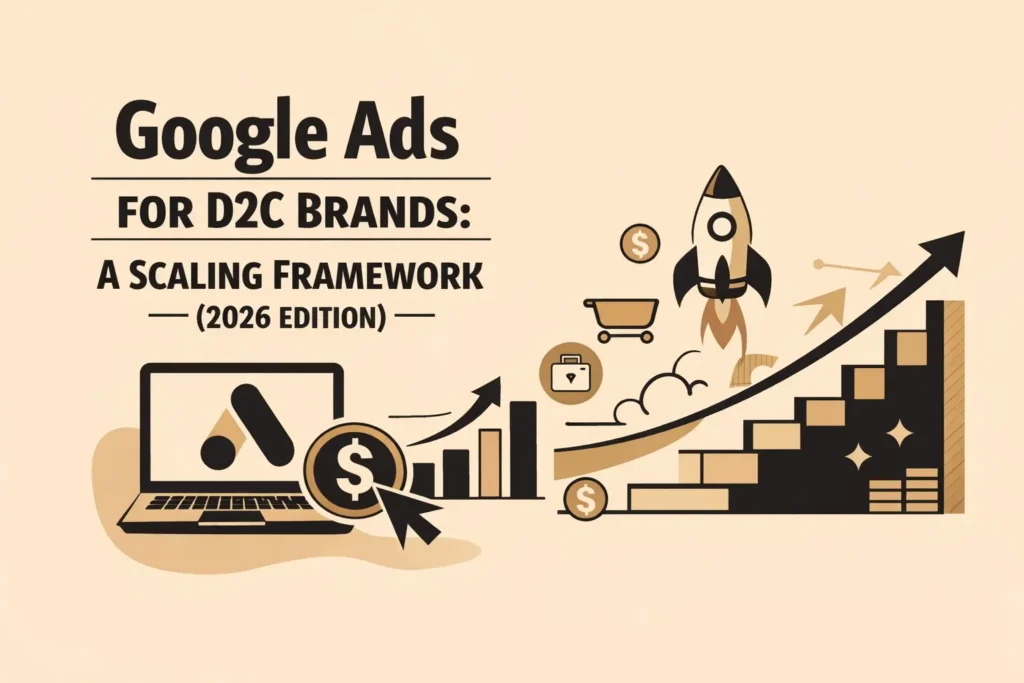
In 2026, Google Ads for D2C Brands isn’t about fancy hacks or aggressive scaling. It’s about building a clear, repeatable system that helps you grow step by step – especially if you’re a beginner.
This guide breaks Google Ads down into a simple scaling framework that founders and small teams can actually follow.
Why Google Ads Still Work So Well for D2C Brands?
Unlike social media ads, Google Ads don’t rely on interrupting people. You’re showing up when someone is already searching for a product like yours.
That’s why platforms like Google Ads remain powerful for D2C brands:
- You reach high-intent buyers
- Traffic quality is usually stronger
- Performance is easier to track
- Scaling is more predictable when done right
The key is not doing everything at once.
The Simple 4-Step Scaling Framework For D2C Google Ads
1. Start With the Right Foundation
Before thinking about growth, you need a clean setup. Most beginner mistakes happen right here.
Your foundation should include:
- Accurate conversion tracking
- Clean product titles and images
- Simple campaign structure (less is more)
- Clear understanding of your margins
At this stage, you don’t need advanced strategies. Basic Search and Shopping campaigns are more than enough. If setup feels confusing, many brands work with a Google Shopping Ads agency to avoid early errors that can get expensive later.
2. Validate Before You Scale
Once your campaigns are live, your job is not to scale. Your job is to learn.
Validation means answering questions like:
- Which products are actually selling?
- Which search terms convert?
- Are you profitable after ad costs?
This phase takes patience. Let campaigns run long enough to gather real data. Pause what doesn’t work and focus on what does. Scaling without validation is one of the fastest ways D2C brands lose money.
3. Scale What’s Already Working
Scaling doesn’t mean launching new campaigns every week. It means doubling down on winners.
Smart ways to scale:
- Slowly increase budgets on profitable campaigns
- Separate best-selling products into their own campaigns
- Expand proven keywords, not random ones
This is also where many founders start thinking about In house vs Agency Google Ads management. In-house gives you control, while agencies often bring faster execution and proven systems. The right choice depends on your team, budget, and growth speed.
4. Optimize for Efficiency, Not Just Growth
In 2026, the brands that win aren’t always the ones spending the most – they’re the ones spending smartest.
Ongoing optimization includes:
- Improving landing page conversion rates
- Refining product titles and descriptions
- Using smart bidding only after enough data
- Testing Performance Max carefully, not blindly
Small improvements in conversion rate or cost per click can increase profit without increasing ad spend.
Common Mistakes D2C Beginners Should Avoid
Many D2C brands fail with Google Ads, not because the platform doesn’t work, but because they rush.
Avoid these mistakes:
- Scaling before profitability
- Running too many campaign types at once
- Ignoring product-level performance
- Expecting instant results
Google Ads reward structure, clarity, and patience.
Final Thoughts
To start with, Google Ads used by D2C brands should not be complex. The results become more predictable and less stressful due to a stable structure, such as foundation, validation, scaling, and optimization.
Either do these ads yourself or outsource; you want to put the emphasis on establishing a repeat system that can be enhanced with time. It is the scale of the D2C brands with Google Ads in 2026 that will grow sustainably.
FAQs
Will Google Ads be effective with D2C brands in 2026?
Yes, Google Ads is still effective due to the daily search for products by people. When an individual searches for that specific thing you are selling, it is a strong force to appear at that time. The aspects that are not effective anymore are running ads without a distinct set and scaling in a rapid way.
Does Google Ads cost too much for a beginner?
It may cost a fortune when you leap into it without planning. In the case of the novices, it does not revolve around a huge outlay in the initial stage. It is better to begin with a minimum and to experiment with what sells and then increase the budget as soon as you are sure what products and keywords make the profits.
What sort of Google Ads campaign should amateurs begin with?
Begin with Search Ads or Shopping Ads. These campaigns are less difficult to manage and provide more explicit information on buyer intent. When you are satisfied and you are ready to see results, then you can think more complicated.
What is the largest error D2C brands commit when using Google Ads?
The biggest error is one of scaling up when things are not lucrative. Even increasing budgets will not solve a campaign that is not performing. Good brands revolve around learning initially and scaling what has already been proven.
Is Google Ads feasible with products that have low prices?
Yes, but it’s more challenging. The low-priced products generally have high conversion rates or greater orders with bundles or upsells. In the absence of this, the cost of advertising may soon cannibalize margins.