Google Ads has emerged as the fastest way to generate leads, drive sales, and improve brand visibility. However, many businesses still face a common question – Should Google Ads be managed in-house or by an agency?
The answer mainly depends on ROI—return on investment. And ROI can vary differently based on factors such as business size, budget, and market maturity.
This blog explains in-house vs agency Google Ads management, compares ROI realistically, and helps businesses decide which approach aligns best with their growth and goals.
Understanding the Difference Between In-House and Agency Google Ads
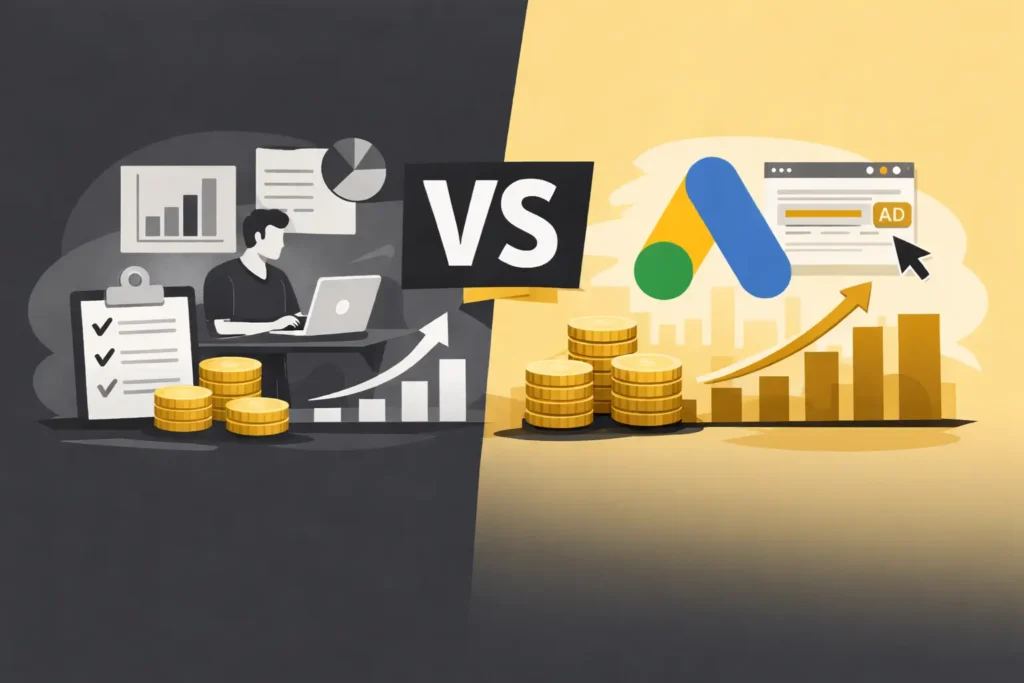
When businesses talk about In-house vs agency Google Ads, the discussion mainly focuses on who manages and executes paid advertising campaigns.
In-house Google Ads management means running campaigns internally by a company’s own marketing team or a dedicated employee. Every decision, optimisation and report stays within the organisation.
Agency Google Ads management refers to outsourcing campaign execution to a specialised agency with experience across platforms, industries, and market conditions.
While both approaches aim to boost performance, their impact on ROI can differ significantly.
What is In-House Google Ads?
Managing Google Ads in-house provides businesses direct control over campaigns. Generally, internal teams understand the product, pricing, and customer journey, which helps maintain brand consistency.
However, in several growing businesses—Google Ads is often managed by a generalist marketer rather than a dedicated PPC specialist. This can slow down optimisation and boost trial-and-error spending.
Limited access to advanced tools, zero exposure to various industries, and slower learning curves often impact performance. This often delays ROI stabilisation.
In-house management can become effective once a business has:
- Consistent ad budgets
- Experienced PPC talent
- Time to invest in testing and optimisation
Without these elements, returns may continue to be unpredictable.
What is Agency Google Ads?
Agencies bring specialised expertise to Google Ads management. Their teams work across multiple accounts and determine what works across various business models and competition levels.
Agencies use structured testing, bidding, and audience targeting processes, which helps reduce wasted spending faster. This is especially valuable in competitive or cost-sensitive markets.
Several growing brands prefer to work with an ecommerce Google Ads agency when they want to scale campaigns much faster without creating an internal team from scratch. The main trade-off is low day-to-day control, but for several businesses, quick performance improvements outweigh this concern.
ROI Comparison: In-House vs Agency Google Ads
From an ROI perspective, agencies often achieve better outcomes in the short term. Their experience helps prevent common mistakes that can waste ad budgets early on.
In-house teams may take longer to attain the exact efficiency level, particularly if they are still learning platform nuances as well as bidding strategies. In the long run, in-house Google Ads can deliver similar results if a business invests in essential training, tools, and talent retention. However, this needs sustained effort and cost.
In fast-moving and competitive markets, expertise often delivers better ROI than simply owning the function in-house.
How Google Ads Works Best for Businesses?
Many small businesses and start-ups often benefit more from agency-led Google Ads because it cuts down experimentation costs and provides quicker insights. Mid-sized businesses often witness the best outcomes with a balanced approach—strategic oversight in-house, backed by agency execution. Larger organisations with steady budgets may create in-house teams but still depend on agencies for complex or high-scale campaigns.
There is no one-size-fits-all approach. The right choice is based on how quickly results are required and how much internal talent already exists.
In Conclusion
The debate around In-house vs agency Google Ads is not about which option is budget-friendly. It is about choosing the right approach that delivers consistent, measurable ROI at a particular stage of business growth. In-house management provides control and long-term alignment, whereas agency management brings speed, specialisation, and scalability.
Businesses that plan their Google Ads strategy around goals, budget, and market conditions are likely to see sustainable results irrespective of the model they choose.