Most D2C brands hit the same wall at some point. Meta costs go up. Scaling search gets harder. And every new channel feels risky.
That’s usually when YouTube Ads for D2C Brands enter the conversation.
Done right, YouTube isn’t just a “branding play.” It’s a channel that introduces new customers to your brand, builds trust before they ever click a product page, and quietly improves performance across your entire Google Ads account.
The key is understanding how YouTube works at each stage of the funnel – and not expecting it to behave like Facebook or Search.
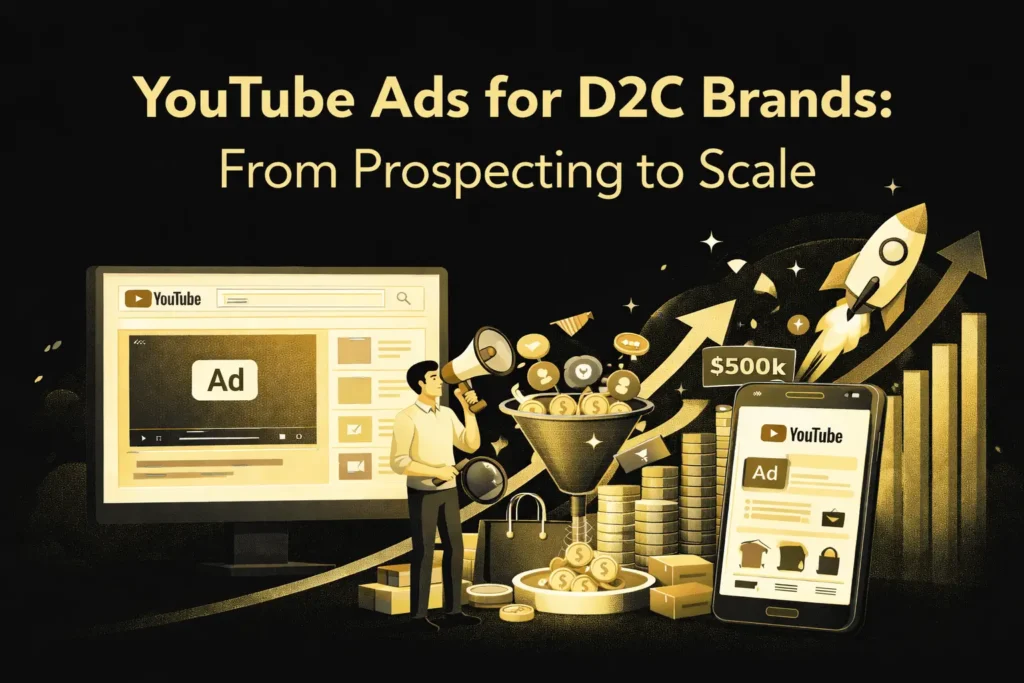
How the YouTube Funnel Works for D2C Brands?
YouTube is most effective when you do not just look at the last-click ROAS and actually make intentional usage at every phase of growth.
Every stage has its individual aim, hundreds and dynamics of audience, and style of creativity.
Stage 1: Prospecting With YouTube Ads
This is where most D2C brands should start.
Prospecting on YouTube is about getting in front of the right people, not forcing an immediate sale. You’re showing up before someone is actively shopping.
At this stage, focus on:
- Skippable in-stream ads
- In-feed video ads
- Short, scroll-stopping creatives
Your video doesn’t need to be perfect. It needs to feel real.
What works well:
- Calling out the problem right away
- Showing the product early
- Speaking like a customer, not a brand
Targeting can be broader than you’d expect. In-market audiences, custom intent, and even open targeting often outperform hyper-layered setups.
For brands already running Google Ads for D2C Brands, this prospecting layer usually leads to stronger branded search volume and higher conversion rates later on.
Stage 2: Consideration & Warm Audiences
Once someone has seen your brand, YouTube becomes a trust builder.
This is where retargeting starts to matter.
You’ll want to speak to:
- People who watched part of your videos
- Visitors who didn’t convert
- Past customers (for repeat purchases or subscriptions)
Creative shifts here. Instead of “What is this brand?” you’re answering:
- Does it actually work?
- Is it worth the price?
- Can I trust them?
Demos of the product, user-created videos, reviews, and founder videos tend to be effective. It is also a step that can be used to develop a more suitable Google Ads structure for D2C brands when the search and shopping ads are combined with direct-to-consumer brands.
Stage 3: Scaling YouTube Ads Without Burning Budget
Scaling YouTube ads is less about increasing spend and more about building repeatable systems.
Brands that scale successfully usually:
- Refresh creatives regularly
- Avoid over-complicated targeting
- Give campaigns time to stabilize
At this stage, YouTube should work alongside:
- Branded and non-branded search
- Shopping or Performance Max
- Remarketing across Google’s network
This is why many fast-growing brands eventually work with a specialized D2C Marketing Agency – YouTube works best when it’s part of a bigger, connected strategy.
What Makes YouTube Ads Actually Work
No strategy survives bad creative.
For YouTube Ads for D2C Brands, the basics matter:
- Hook attention in the first few seconds
- Show the product immediately
- Assume most people won’t turn the sound on
- Keep prospecting videos short and focused
YouTube rewards clarity more than polish.
Final Thoughts
YouTube ads, when applied in the right way, will enable you to get more qualified customers, heat them quicker, and expand without necessarily relying on a single avenue.
It’s not about chasing instant ROAS. It’s about building demand that makes everything else work better.
If you’re already investing in Google Ads for D2C Brands, YouTube might be the channel that helps you scale more sustainably – and with fewer surprises.
FAQs
Are YouTube ads effective for small D2C businesses?
Yes. They come in very handy with the case of brands aiming to create awareness prior to sale. You do not need a huge budget; clear messages and time will suffice.
What is the time frame of realising the benefits of YouTube advertising?
It usually takes a few weeks. We achieve improved results on the entire sales funnel and not on the first day alone on YouTube.
Should YouTube advertisements be used instead of Meta or Search?
Never. YouTube is not a substitute for search and shopping advertisements.
So what is the worst thing D2C brands can do with YouTube?
Firing it like an immediate reaction channel and quitting it prematurely.