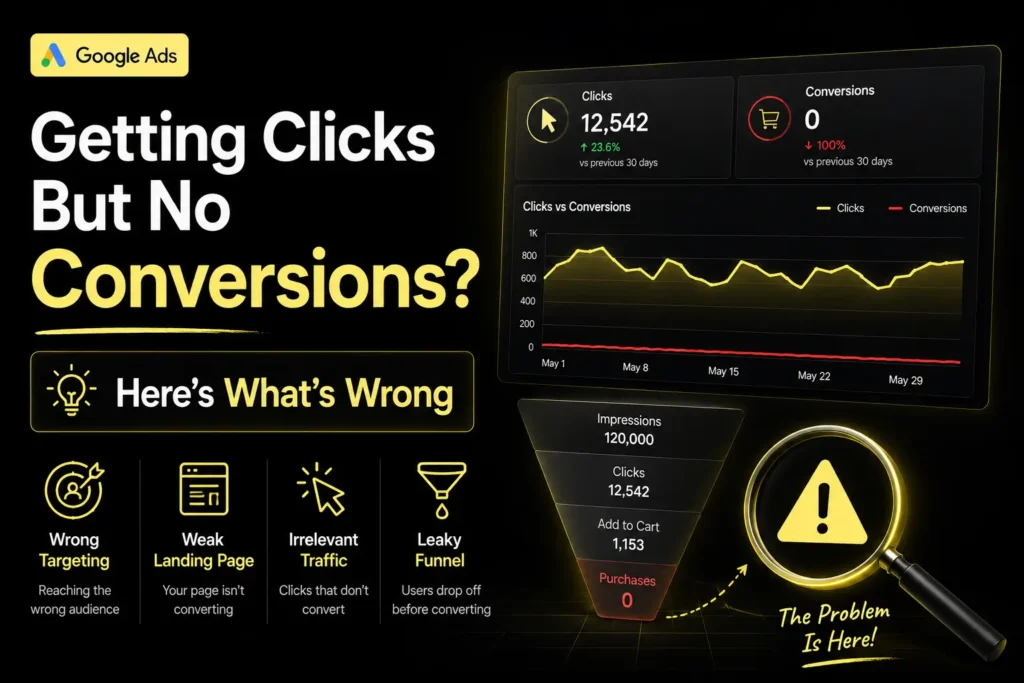
Clicks but no conversions is not an uncommon phenomenon, and it’s safe to assume that you’re probably frustrated beyond words. You have traffic coming through, the clicks appear promising and hopeful, but then, when you go to see how many of those clicks resulted in conversions, there is nothing to be seen. You’re losing out on your money.
If your website is experiencing clicks but no conversions, there’s no need to panic because you probably still have a good product. The problem lies in the area that other advertisers often overlook.
Why You’re Getting Traffic But No Sales?
One of the more common mistakes is optimising for traffic volume instead of conversion intent. Traffic without purchase intent is just noise. Say you’re running ads for premium skincare and your keywords pull in people searching for “cheap skincare hacks.” They click out of curiosity, but they were never going to spend.
That’s where the high clicks, low conversions problem starts. This is also why many brands experience Google Ads clicks but no conversions, even when click-through rates look strong. The campaign reaches people. It just doesn’t reach buyers.
Main Reasons For Getting Clicks But No Conversions
1. Your Landing Page Is The Problem
Sometimes the ads themselves are fine. The landing page is what kills the conversion.
Page speed is the first place to look. When a page loads slowly, people leave before reading the headline – especially on mobile. Compressing images, removing unnecessary scripts, and simplifying page structure all help reduce bounce rate and landing page drop-off significantly.
Messaging matters just as much. When someone lands on your page, they should immediately understand three things:
- What you sell
- Why it matters to them
- What they should do next
When that’s unclear, they leave. Also check mobile – most ad traffic comes from phones, but many landing pages still feel clunky on small screens. Test on different devices before spending more on traffic.
2. You’re Attracting The Wrong Audience
Not every click has value. Broad targeting pulls in low-intent users. Someone searching “how does protein powder work” is in a completely different mindset from someone searching “buy whey protein online.” Targeting both the same way wastes budget.
This is one of the main reasons for high clicks but low conversions. A lot of businesses asking “why my ads are not converting despite clicks” find that targeting was simply too wide. To fix it:
- Focus on high-intent keywords
- Add negative keywords consistently
- Separate campaigns by buyer intent
- Match search terms to dedicated landing pages
3. Your Offer Doesn’t Feel Strong Enough
What happens when the visitor likes your content but is still not quite sure? Does it convey its unique selling point from the get-go? How about social proof — do you include any reviews or guarantees in your page? People like to be certain before taking action, and subtle cues can be the difference-maker here.
Companies partnering with a Google shopping ads agency frequently experience improvements in their campaigns without adjusting them at all, thanks to better product presentation and trust-building.
How To Improve Ad Conversion Rate
If you want to optimize ads for conversions, the ad creative is rarely where the real leverage is. Everything after the click matters. Here’s where to focus:
- Make the ad relevant to the landing page: In case the ad promises something to the users, be sure to communicate that information in the landing page too. If this doesn’t happen, the potential customer loses confidence prior to conversion.
- Be specific with your CTAs: Non-specific CTAs such as “Submit” and “Learn More” will perform much worse than targeted CTAs such as “Get My Free Quote,” “Try Me Out Now,” or “Schedule My Demo.”
- Simplify your form: Make sure that your form is short and sweet for easy conversions.
- Optimize via consistent testing: Good ad campaigns usually do not start well. Keep on testing various aspects of the ad, such as its headline, CTA, picture, or layout.
Google Ads structure for D2C brands will have a positive impact. Improved Google Ads structures help with better targeting accuracy and relevancy.
Finally, reduce CAC using YouTube ads for retargeting users who clicked on the ad but didn’t make a purchase.
Metrics That Actually Matter
Clicks alone don’t tell the full story. Watch these instead:
- Conversion rate – are visitors taking action?
- Cost per acquisition (CPA) – what does each conversion cost?
- Return on ad spend (ROAS) – is the spend paying back?
- Bounce rate – are people leaving immediately?
- Lead quality – are conversions turning into real customers?
FAQs
1. Why do Google Ads receive clicks but no conversions?
Because of landing page optimization issues, targeting flaws, too slow page loading speed, and messaging mismatch. Clicks are not an issue; it is what happens afterward that will determine your conversion.
2. What measures will increase my ad conversion rates?
Optimize page speed, create an effective landing page, make a compelling call-to-action message, and target visitors who have more intention. Almost all conversion optimization issues come from landing pages and not ads.
3. What measures can lower bounce rates on landing pages?
Speed up the page, enhance navigation, and ensure relevance with respect to the keyword that brought up the ad. Mobile usability should be the priority since mobile devices generate more traffic.