If you use Google Ads, you may have asked yourself the following question:
Would it be better to put money into Performance Max campaigns, or would the regular search campaigns yield better results for me?
It all boils down to the individual needs and preferences that you will have as an advertiser. But they work in very different ways. And if you choose the wrong one, your ROI can suffer fast.
In this guide, you’ll learn the real difference between performance max vs search campaigns, how each campaign works, and which one usually delivers better return on ad spend.
What Are Google Search Campaigns?
Google search campaigns are the original Google Ad type.
Google places your ad on the page when users enter a keyword into Google.
For instance, if you search for “top running shoes,” your ad could be displayed at the top of the page.
The biggest advantage – High intent.
The customers are already looking for what they need, which puts them closer to making a purchase.
Search campaigns offer more control over:
- keywords
- match types
- ad copy
- landing pages
- bidding strategies
- audience targeting
This is why many companies continue to use Search campaigns to generate leads and make sales. A good paid search management company will often start with Search campaigns because they’re easier to optimize and measure.
What Is Performance Max?
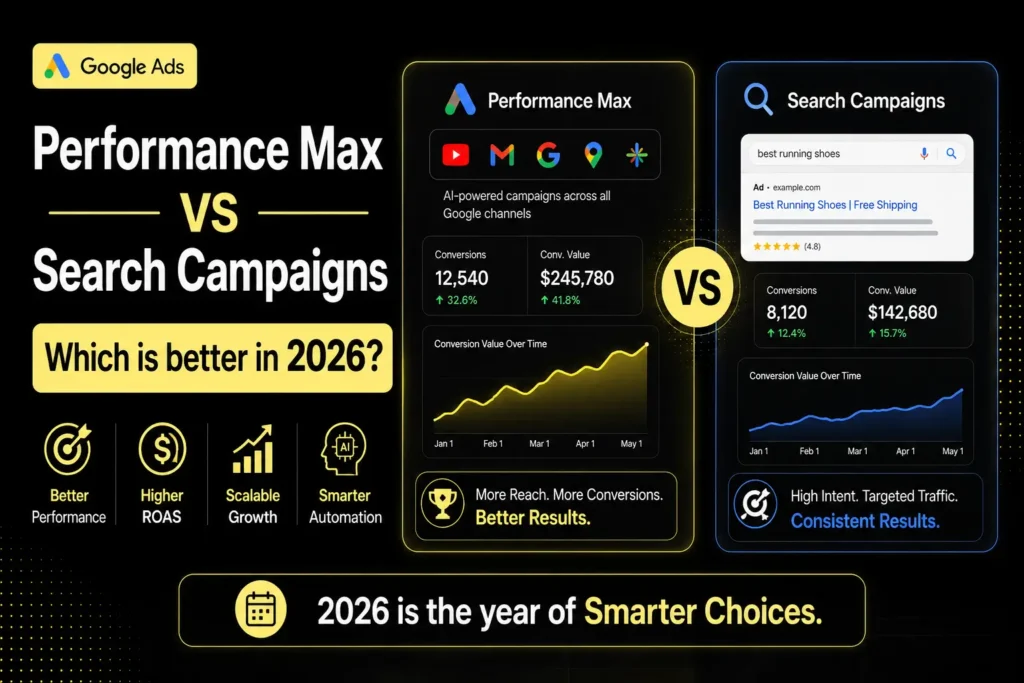
Performance Max, also called PMax, is Google’s AI-driven campaign type.
In contrast to advertising solely in Google Search, Performance Max can display ads on:
- Google Search
- YouTube
- Gmail
- Google Maps
- Discover
- Display Network
- Shopping
You upload creative assets, audience signals, and conversion goals.
Then Google’s machine learning handles the rest.
That’s the biggest difference in the debate around google performance max vs search campaigns.
Search gives you manual control. Performance Max gives Google automation.
Performance Max vs Search Campaigns: The Biggest Differences
Here’s a simple comparison.
| Feature | Search Campaigns | Performance Max |
| Targeting | Keyword-based | Audience + automation |
| Control | High | Limited |
| Channels | Google Search only | Multiple Google properties |
| Optimization | Manual | AI-driven |
| Best For | High-intent leads | Broad reach and scaling |
| Reporting | Detailed | Less transparent |
This is why many advertisers compare pmax vs search ads performance before increasing ad spend. Businesses also often evaluate In-House vs Agency Google Ads management when deciding how to maximize campaign performance and ROI.
One gives precision. The other gives scale.
Which Campaign Delivers Better ROI?
Now let’s answer the big question.
In most cases, Search campaigns deliver better ROI for businesses focused on leads.
Why?
Because search intent matters.
Someone actively searching “emergency plumber near me” is much more likely to convert than someone casually browsing YouTube.
That’s why Search campaigns often produce:
- Higher conversion rates
- Lower wasted spend
- Better lead quality
- More predictable performance
However, Performance Max can outperform Search in ecommerce.
Especially when you have:
- Large product catalogs
- Strong conversion data
- High-quality creative assets
- Multiple audience segments
Google announced that advertisers employing Performance Max experienced an average 18% improvement in conversion rate at a comparable CPA than non-PMax campaigns.
However, there’s a catch. Performance Max needs good data.
Without enough conversion history, Google’s automation struggles.
That’s why many brands first build strong Search campaigns before scaling with PMax. You can see this approach in many successful Google Performance Max case study examples.
When Search Campaigns Are the Better Choice
Search campaigns usually work best if you:
- Generate leads
- Offer local services
- Have a smaller budget
- Need detailed reporting
- Want keyword-level control
- Need predictable ROI
For example, law firms, SaaS companies, dentists, and B2B brands often perform better with Search campaigns.
Why?
Because targeting intent matters more than reach.
When Performance Max Works Better
Performance Max shines when you want scale.
It works especially well for ecommerce brands.
A strong Google Performance Max ecommerce strategy can help stores reach buyers across multiple Google platforms from a single campaign.
Performance Max is usually a good fit if you:
- Sell physical products
- Have strong creative assets
- Already generate conversions consistently
- Want to expand beyond Search traffic
- Need automated optimization
The system improves over time because Google’s AI learns which audiences convert best.
Can You Run Both Together?
Yes. In fact, many advertisers get the best results by combining both.
Here’s a simple strategy:
- Use Search campaigns for high-intent keywords
- Use Performance Max for broader reach and remarketing
- Compare conversion quality regularly
- Exclude branded terms where needed
- Monitor overlap carefully
This hybrid approach gives you control and scale at the same time.
And for many businesses, that creates the best long-term ROI.
Final Thoughts
The debate around performance max vs search campaigns really comes down to one thing:
Control vs automation.
Search campaigns give you precision targeting and stronger intent.
Performance Max gives you wider reach and AI-powered scaling.
If your goal is lead generation and predictable ROI, Search campaigns are usually the safer option.
If you run an ecommerce brand and want more scale, Performance Max can become a powerful growth channel.
For many businesses, the smartest move is using both together.
That way, you capture high-intent traffic while also letting Google’s automation find new converting audiences.
FAQ
1. Is Performance Max better than Search campaigns?
Not always. Performance Max is better for scaling and ecommerce. Search campaigns are usually better for lead generation and keyword targeting.
2. Does Performance Max replace Search campaigns?
No. Google designed Performance Max to complement Search campaigns, not fully replace them.
3. Which campaign type is easier to optimize?
Search campaigns. They provide more visibility into keywords, search terms, and bidding performance.
4. What is the best Google Ads strategy for beginners?
Most beginners should start with Search campaigns first. Once conversion tracking and data improve, they can expand into a Google Ads performance max strategy for additional growth.