Marketing budgets used to run on faith.
You spend your cash on the television commercial or the newspaper advertisement, hoping that everything will turn out well, and wait till the month’s end to see how much was sold.
Sometimes they did. Often they didn’t. And you almost never had a clean way to connect the ad to the result.
That’s not a great position to be in when someone’s asking you to justify the spend.
Things have shifted. Businesses now want proof – not to reach estimates or audience projections, but actual numbers showing where the money went and what came back. That’s exactly why Performance marketing ROI has become the benchmark most brands hold their campaigns to. It’s all about responses and results, not assumptions and hopes.
There are no investments in advertising; there are only investments in actions – a click, lead generation, a sale, an app download. And you can tweak your efforts during the process and when someone asks what worked, you can show them.
Here’s why performance marketing consistently outperforms traditional advertising on return – and why more brands are moving budgets in that direction.
Why Does Performance Marketing Generate Better ROI?
Measurability. That’s the short answer.
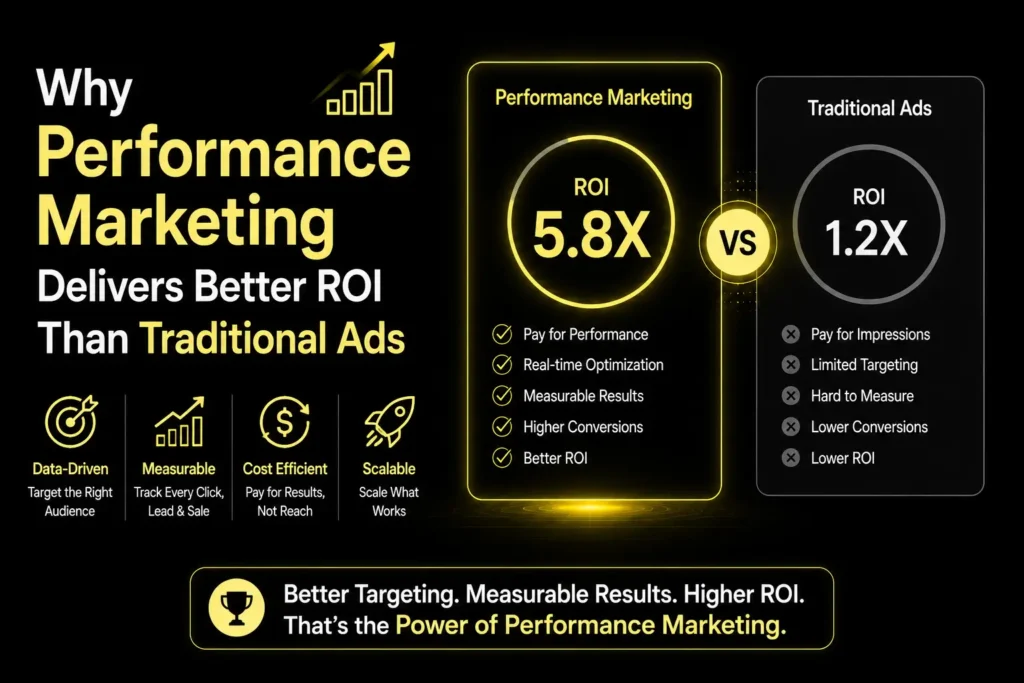
But it’s not just about seeing numbers – it’s about what those numbers let you do. When you know what’s working, you fund it more. When you see what isn’t, you cut it. This is not something that traditional marketing campaigns usually afford you. You allocate the budget, run your marketing and then deal with the outcome.
Here are the specific factors that push performance marketing ROI higher.
1. Every Action Is Trackable
One of the biggest performance marketing benefits is that nothing happens invisibly. You can see exactly what your spending is doing.
You can track:
- Cost per click (CPC)
- Cost per acquisition (CPA)
- Conversion rates
- Return on ad spend (ROAS)
- Customer lifetime value
That’s not just useful for reporting. It changes how you make decisions. Instead of gut feel, you have actual performance data to work with – and that gap between guessing and knowing is where a lot of wasted budget lives.
2. Budget Is Spent More Efficiently
Traditional advertising asks you to spend big before you know anything. A TV slot, a print placement, a billboard – the money goes out the door before a single lead comes in.
Performance marketing works differently. You test with a smaller budget first, see what the numbers say, pull back on what’s not converting, and put more behind what is. It’s a much shorter feedback loop, and that shorter loop is where the efficiency comes from.
Brands running data-driven campaigns consistently outperform those relying on traditional channels for customer acquisition – not because the tools are magic, but because you’re not flying blind.
3. Real-time Optimization Improves Results
Once a print ad goes out, it’s done. In case it fails to deliver, you just wait until the next cycle.
On the contrary, with performance marketing, you have an option to do something about it during the process:
- Pause ads that aren’t converting
- Shift targeting to a better audience segment
- Test new creative
- Move budget toward what’s already working
- Fix the landing page that’s losing people
None of these changes are dramatic on their own. But applied consistently over time, they compound – and that compounding is where a lot of the ROI difference between performance and traditional advertising actually shows up.
Performance Marketing Vs Traditional Advertising
Understanding the difference helps explain why ROI often favors performance marketing.
| Performance marketing | Traditional advertising |
| Fully measurable | Limited measurement |
| Pay for results | Pay for exposure |
| Real-time optimization | Fixed campaigns |
| Precise audience targeting | Broad audience targeting |
| Flexible budgets | Higher upfront costs |
| Immediate reporting | Delayed reporting |
Traditional advertising isn’t dead. For brand awareness and scale, it still does things performance channels can’t. But when businesses need to grow efficiently and show that marketing spend is actually doing something, performance marketing vs traditional advertising isn’t much of a contest – they’re measuring different things, and performance marketing is measuring the things that matter to most budgets.
How Better Targeting Increases Performance Marketing ROI
Showing an ad to the wrong person is just money leaving your account.
Performance platforms let you get specific – reaching people based on:
- Search intent
- Interests
- Demographics
- Online behavior
- Purchase history
- Geographic location
An ecommerce brand can target someone actively searching for their exact product, in the right city, who already visited the site and didn’t buy. That kind of precision doesn’t exist on a billboard or a radio spot. And when fewer impressions go to waste, the cost per acquisition drops.
Businesses running Google Performance Max ecommerce campaigns push this further by using Google’s machine learning to serve ads across Search, Shopping, YouTube, and Display from one campaign – automatically shifting bids and placements toward whoever is closest to converting.
Why Ecommerce Brands Prefer Performance Marketing
Ecommerce runs on thin margins and fast decisions. Every marketing dollar has to pull its weight, and performance marketing makes that relationship between spend and revenue direct enough to actually manage.
Key advantages include:
- Accurate sales attribution
- Dynamic product advertising
- Retargeting abandoned visitors
- Automated bid optimization
- Continuous testing opportunities
Because spend ties so directly to revenue, profitable campaigns can be scaled without losing control of acquisition costs. A lot of brands bring in a Google Ads agency for ecommerce to sharpen that further – getting the campaign structure, bidding logic, and creative testing to a level that’s hard to reach when you’re managing ads alongside everything else.
Conclusion
The question businesses are asking has changed. It used to be “did people see our ad?” Now it’s “did the ad do anything?”
Performance marketing ROI is built to answer the second question. Precise targeting, real-time optimization, and paying only for results give businesses a level of control that traditional advertising simply wasn’t designed to offer.
Traditional ads still earn their place for awareness and reach. But for brands that need to grow efficiently – and need to show that marketing spend is actually working – the data tends to point in one direction.
FAQs
1. What is performance marketing ROI?
The metric is a way of gauging the effectiveness of campaigns wherein you pay based on actions taken, such as clicks, leads, or conversions. Put simply, it tells you if your campaign was profitable or not.
2. Performance marketing versus conventional marketing – which one is better?
When results and conversions are what you’re after, definitely performance marketing. There’s just too much that can be done during the course of a campaign.
3. What types of companies does performance marketing suit best?
Ecommerce brands, SaaS companies, local service businesses, and lead-generation companies tend to see the strongest results – anywhere the conversion can be tied cleanly back to the ad.
4. Can small businesses use performance marketing?
Absolutely. The flexible budget model is actually well-suited for smaller operations. Start with a modest spend, figure out what works, then grow from there – rather than betting big on a single placement upfront.