If you watch your ad money get wasted times you will see something that always happens. Your targeting is okay. Your ads look nice. Something is not working right. And that something is usually the difference between what a brand thinks makes people buy things and what really makes them buy things.
Effective, High-converting ad campaigns work on the principles of truth of human behavior. People are not buying things the way they believe they are. They definitely do not buy things the way brands think they do. Ad campaigns that work are built on understanding what really makes people buy things and that is what converting ad campaigns are all about. They are about understanding people and what makes them buy ad campaigns products.
Why Consumer Psychology Marketing Changes Everything
Ask someone why they bought something and they’ll give you a logical answer. The price was right. They needed it. The reviews checked out. What they won’t tell you – because they often don’t know – is that the decision was mostly made before any of that analysis happened.
Consumer psychology marketing starts from this reality. The goal is not to tell buyers facts, it’s to link with what’s already on their minds.
A mother who is buying a car for her family does not think about how powerful the car’s she thinks about her kids being safe. A man who joins a gym does not think about how many calories he will burn; he imagines himself to be a person he really likes.. Ads that speak to the real thing convert. Ads that speak to the stated thing don’t.
The Triggers Behind Ads That Actually Work
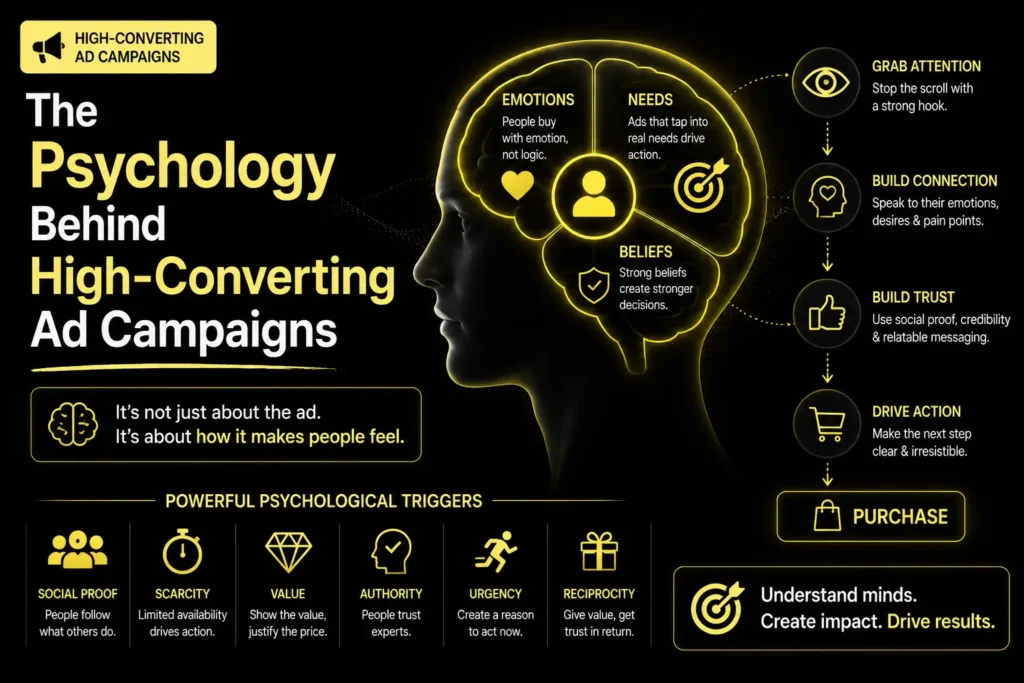
Social proof
Word-of-mouth used to occur among neighbors. Today it occurs at scale via reviews, ratings, and before-and-after photos. The psychology behind it has remained unchanged, however. Individuals will seek out other individuals’ experience to de-risk their own purchase decision.
One specific, in-depth testimonial from someone who resembles your ideal customer can do the heavy lifting that three paragraphs of brand copy cannot, not because of its informativeness, but because of its credibility.
Scarcity and urgency
Nobody rushes to buy something that’ll still be there next month. Limited stock, a closing enrollment window, an offer that expires Friday – these things push buyers off the fence because the cost of waiting suddenly becomes real.
The only rule: it has to be true. Countdown timers that reset, “limited” offers that never actually end – people notice, and once they notice, the trust is gone.
Authority
A new buyer is rolling the dice. They haven’t heard of your brand, can’t try the product before they purchase, and they have no reason to trust what you say any more than anyone else’s. Authority signals – a powerful testimonial, an established certification, press about you in an outlet they trust – bypass all that.
Reciprocity
Give people something worth having before you ask for anything. A useful guide. A real answer to a problem they’ve been Googling. A free consultation that actually helps. When you do that, most people feel some pull to return the favor. It’s not manipulation; it’s just how human relationships work, and good ad campaign strategies know how to use it without being cynical about it.
Emotional Advertising: What People Are Actually Buying
Nobody buys a fitness program. They buy the confidence that comes from feeling good in their body. Nobody buys accounting software. They buy fewer headaches at tax time and the feeling of having their business under control.
Advertising for conversions which works backwards from the emotional result to the product is more effective than vice versa, every time. It is where the story comes into its own. The story invites readers into a world with which they are familiar, leads them to solve a problem which they understand and then provides them with a map on how to solve it. And I am not joking. This is a way humans have always trusted each other.
The practical implication: before writing a word of ad copy, get specific about what your customer is actually trying to feel. Then write toward that.
You only have about two seconds. No amount of psychological sophistication helps if nobody reads past the first line.
Scroll behavior is the default. If you’re getting clicks but no conversions, the problem is often not your targeting. It’s the message and the psychology behind it.
Wrapping up
Budget alone doesn’t win on paid advertising. What wins is understanding that every ad is a small psychological moment – someone either recognizes themselves in it or they don’t, trusts it or they don’t, acts or scrolls.
High-converting ad campaigns are what happens when that understanding gets applied consistently, not just to the creative, but to the offer, the timing, the proof, and the task. Psychology isn’t a trick layered on top of marketing. It’s what marketing is made of.
Whether you manage campaigns in-house or work with a Google Adwords management company, the brands that understand human behavior are usually the ones that see the best results.
FAQs
1. What are high-converting ad campaigns?
They are the campaigns, which encourage a relevant percentage of “wanted actions” (like purchases, sign ups, inquiries) through right targeting combined with messaging reflecting how customers really feel and think.
2. Why does consumer psychology matter in marketing?
Because people don’t consume the way they believe they do. Having a thorough understanding of the emotional and social influences that lead to purchase, marketers can pen advertisements which persuade, and not simply communicate.
3. Which psychological trigger works best in advertising?
It varies. The audience and the product. Social proof, urgency, authority, emotion-driven stories all have unique functions. The best campaigns utilize more than one.