You’re a business owner. You want more customers. And at some point along the way, you were told you needed “to run ads.” But which ones? And on which platforms? And for what reason?
Those are all good questions! I hear these arguments about Google Ads vs Meta Ads constantly among marketers-and in all honesty, there is no single, perfect answer. Once you dig beneath the surface of both though the choice pretty much makes itself.
Google Ads vs Meta Ads-what’s The Big Difference?
The most fundamental difference between the two platforms is intention.
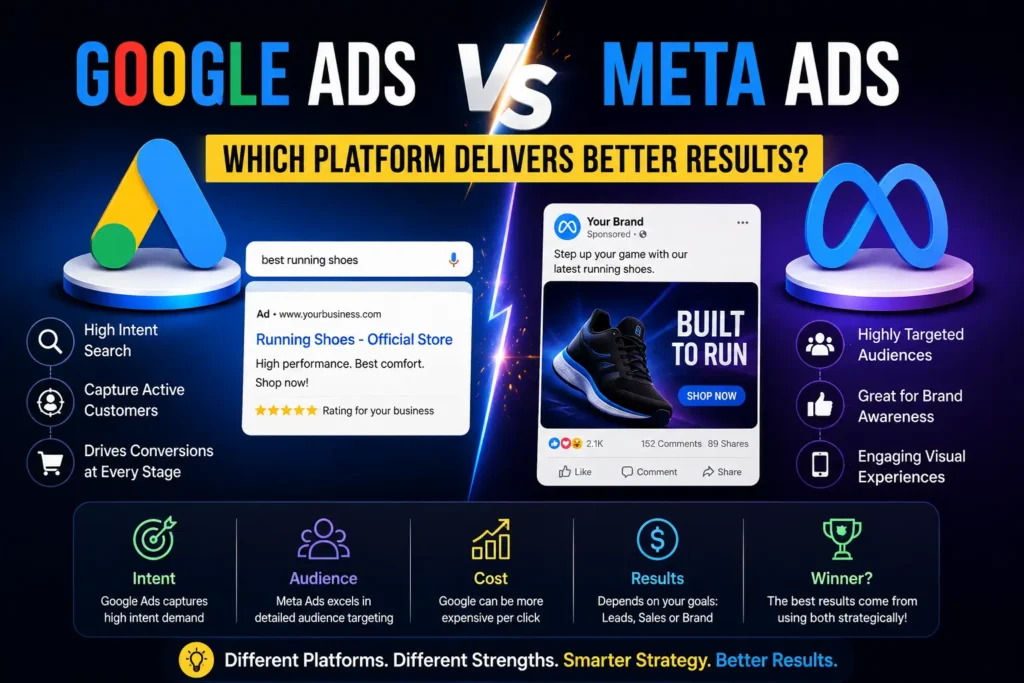
When a user searches on Google, he/she is looking for something. A user who searches for “best accountant in USA” or “buy leather sofa online” has a requirement and they are in search of an answer/ solution. Google Ads sit right in that moment. So Google excels at capturing demand that already exists.
Meta Ads work the other way around. On Facebook and Instagram, people aren’t searching for anything. They’re scrolling through their feed, watching Reels, checking Stories. Your ad appears in that space – not because they asked for it, but because Meta thinks they might be interested.
So in simple terms: Google catches buyers. Meta creates them.
Why Google Ads Remains The Leader For Lead Generation
If you need leads, Google is hard to beat. People searching with high intent are much closer to taking action – filling a form, making a call, placing an order.
Google Ads for lead generation works well because:
● The traffic already has a specific need
● Keyword targeting puts you in front of the right searches
● Conversion tracking shows you exactly what’s working
● ROI is measurable from day one
Especially for D2C Brands, your campaign structuring can matter as much as your budget. Using a correct Google Ads Structure for D2C Brands allows you to manage ad spend, raise your quality scores, and make your budget work for you rather than working for irrelevant customers.
How Meta Ads Drive Business Growth
Meta has changed a lot. Advantage+ campaigns and AI-powered delivery have made manual audience targeting far less important than it used to be. Today, creative quality and first-party data do most of the heavy lifting.
Meta Ads for business growth work particularly well for eCommerce, fashion, beauty, and lifestyle brands – basically any category where visuals sell the product. The platform gives you:
● Enormous audience reach across Facebook and Instagram
● Video formats like Reels and Stories that feel native, not intrusive
● Heavy retargeting to recapture the visitors of your site
● Lower CPM than search
Beyond reach, Meta builds something harder to measure but equally important – emotional connection. People see your brand repeatedly before they’re ready to buy. When they get ready to buy, they are comfortable coming to you and “knowing you” and buying from you.
Google Ads vs Facebook Ads: Which Generates Better Results?
Looking at Google Ads vs Facebook Ads – the reality is it depends on your goal.
Google wins when someone needs to act now. A person searching for “emergency plumber near me” or “buy iPhone 15 online” is ready. Google Ads meet them at that moment.
Facebook wins when you need to build awareness first. If nobody’s heard of your brand, you can’t wait around for them to search for it – because they won’t. Meta puts you in front of them before they know they need you.
So think of it this way:
● Need leads or sales right now? Google Ads.
● Need people to know your brand exists? Meta Ads.
● Want both, long-term? Use both together.
These platforms aren’t competing with each other inside your strategy. They cover different parts of the customer journey.
Meta Ads vs Google Ads for Brand Awareness
If brand awareness is your primary goal, Meta usually wins – and it’s not particularly close.
Meta Ads vs Google Ads for brand awareness favours Meta because of how the formats work. A 15-second Reel can show your product, tell a small story, and make someone feel something. A search ad – no matter how well written – can’t do that.
Meta also gives you social signals: likes, shares, comments. These build trust in a way that search results simply don’t.
That said, YouTube campaigns within Google Ads are genuinely powerful for awareness too. For brands selling higher-consideration products where buyers research before committing, YouTube video ads can do serious work.
Meta Ads vs Google Ads Comparison: ROI and Measurement
Here’s where a lot of advertisers go wrong. They look at the ROAS number inside one platform and call it a win or a loss. But that number only shows conversions that the platform is willing to take credit for.
A proper Meta Ads vs Google Ads comparison needs to look at the full picture – customer acquisition cost, lifetime value, and total revenue impact across all channels.
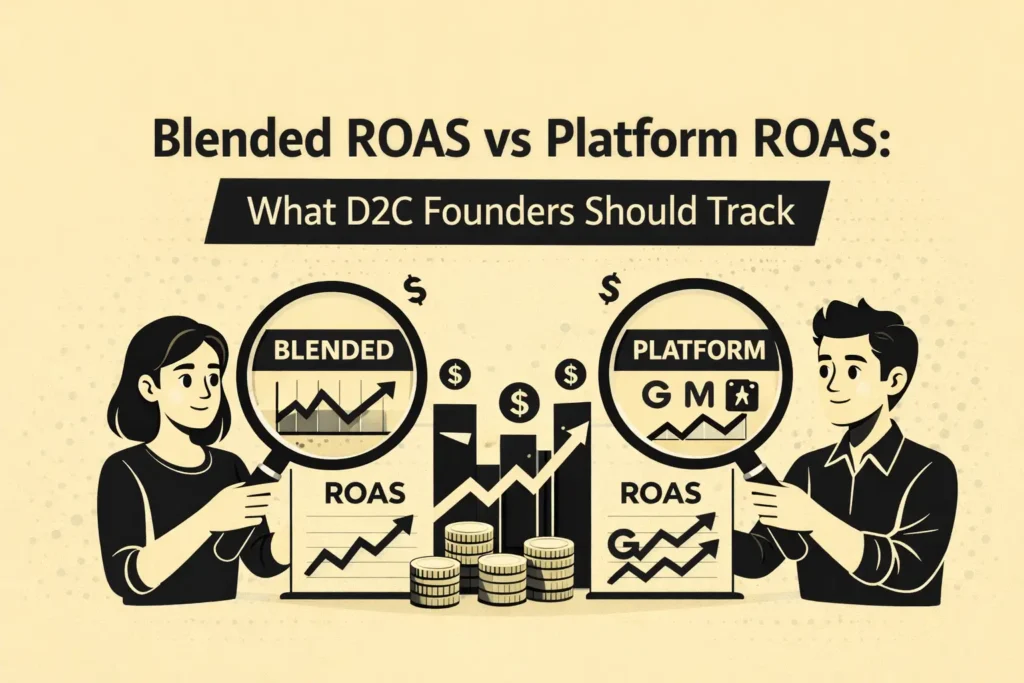
This is exactly why the Blended ROAS vs Platform ROAS conversation matters. Blended ROAS divides your total revenue by your total ad spend across every channel. It tells you how the whole online advertising strategy is performing – not just one slice of it. As privacy changes continue to limit tracking, blended measurement is becoming the more reliable standard.
Which Platform Is Best for eCommerce?
For most eCommerce businesses, the answer is both – used together.
Google Shopping captures buyers at the bottom of the funnel. They searched for exactly what you sell, saw your product image and price, and clicked. That’s about as warm as traffic gets.
Meta, meanwhile, builds the top of the funnel. Someone sees your product on Instagram, doesn’t buy it, and then gets retargeted three days later with the exact item they viewed. That combination – discovery on Meta, conversion on Google – is what full-funnel advertising actually looks like in practice.
Many growing brands work with a Google Shopping Ads Agency to get the Google side right. Feed optimization, bidding structure, and campaign segmentation take time to dial in, and getting them wrong means paying for clicks that don’t convert.
Conclusion
There are no winners in Google Ads vs Meta Ads – because neither is actually competing!
Google Ads is the ultimate lead generation/high-intent conversion tool. Meta Ads is the ultimate brand awareness/cold audience warmer-upper/almost converter-getter-back-home tool.
In 2026, the businesses getting top results from digital advertising are not picking one over the other.They’re using both – with a clear strategy for each, and a measurement system that looks at the full picture rather than just one platform’s dashboard.
FAQs
1. What budget do I need to start?
In India, ₹10,000–₹20,000 per month is a reasonable starting point for either platform. Below that, you don’t collect enough data to make smart decisions. More important than the budget size is making sure it’s concentrated enough to get meaningful results.
2. Which platform suits a service business vs a product business?
Service businesses – clinics, law firms, coaching institutes, agencies – usually see stronger returns from Google Ads because clients search with clear intent. Product businesses in fashion, beauty, food, or lifestyle typically get more traction starting with Meta, where discovery is driven by visuals and interest rather than search.
3. Can a small business run both platforms at the same time?
Yes- but one at a time! If you have current enquiries/sales to generate, start with Google. Once it is producing sales then bring in Meta for reach/retargeting. If you spread it thin across both it might not give you enough data for optimization.