You can have a generous budget and sharp bidding and still watch your campaigns underperform. Often the missing piece is simple: your ads don’t line up with what people typed into the search bar. Work to Improve Google Ads Quality Score and you’re really fixing that gap, through ad relevance, expected CTR, and landing page experience.
One thing to know up front. Google treats Quality Score as a diagnostic tool, not a ranking lever. It is a 1-10 metric that appears at the keyword level, and is not an auction ranking factor.
What Is Google Ads Quality Score?
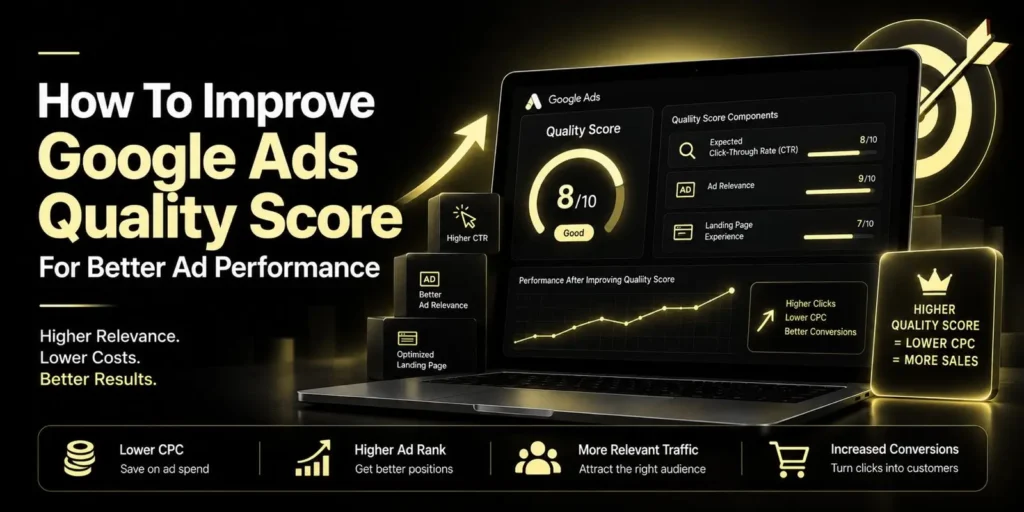
Basically, it’s a one-minute health check of your keywords and ads. Three Google Ads Quality Score Factors sit behind it:
- Expected click-through rate (CTR)
- Ad relevance
- Landing page experience
Each one is marked “Above average,” “Average,” or “Below average.” That’s useful, because you don’t have to guess what’s dragging a keyword down. Google tells you.
How To Improve Google Ads Quality Score
Don’t try to fix everything at once. Find the weakest component and start there.
1. Improve Ad Relevance
Check: if someone looked up this keyword, is the ad going to seem relevant? If not, the fix is usually structured. Put similar keywords together in tight ad groups, then write ads for each theme.
Take “running shoes” and “formal shoes.” Different shoppers, different needs. Give them their own ad groups and the messaging almost writes itself.
2. Improve Expected CTR
Expected CTR is Google’s prediction of how likely people are to click your ad. There is a clear difference between effective and ineffective headlines here. Explain what you sell, what it does for them or what problem you solve.
Continue experimenting with headlines and calls to action. Use caution. To get that lead or sale, you’ll need to get the click there in the first place.
3. Improve Landing Page Experience
Your ad makes a promise. The landing page has to keep it. If the ad is for one product, send people to that product, not the homepage and hope that they’ll find it.
Make the page easy to move around and actually useful. Then check it on your phone and on a desktop. A page that looks great on one screen and breaks on the other will cost you.
Google Ads Quality Score Optimization Tips
Good Google Ads Quality Score Optimization is a habit, not a one-off project.
Start by pulling up keywords rated “Average” or “Below average.” Then work out which of the three components is the culprit. Look at conversion rate, CTR, and your other business numbers alongside it. Quality Score should back up your thinking, not replace it.
And please don’t edit keywords just to push the number up. Change things because they’ll make the ad more relevant or the experience better. If you do that well, the score tends to take care of itself.
Google Ads Quality Score Analysis
A regular google ads quality score analysis can show you where an account is quietly leaking performance. Open Google Ads, check the score and its component ratings, and compare them with what your campaigns are really delivering.
Here’s something people miss: a keyword with a low score can still convert well. If it’s making you money, a mediocre number isn’t a reason to panic. Business results come first. The diagnostic data adds context.
Quality Score vs Ad Rank
People mix these two up all the time, but they aren’t the same. Quality Score is a diagnostic. Ad Rank decides whether your ad shows at all, and where.
Google works out Ad Rank at auction time, using signals like ad quality and landing page quality. The 1 to 10 score isn’t plugged in directly.
Improve Google Ads Quality Score Before Scaling
Pouring more budget into a messy account just makes the mess more expensive. Before Google Ads scaling, get the basics right: focused ad groups, relevant ads, and landing pages that earn their traffic.
A google shopping ads agency can handle the product centric aspect of campaign management and optimization if you own an online business.
Final Thoughts
To Improve Google Ads Quality Score, go after relevance, not volume. Build cleaner ad groups, write ads people want to click, and send them somewhere that delivers. Then read your google ads quality score analysis next to your conversion and revenue data.
Do that, and your campaigns get stronger while your optimization stays tied to results that matter.
FAQs
1. What is a good Google Ads Quality Score?
Many advertisers see 7 or above as a solid benchmark. Google’s advice, though, is to treat it as a diagnostic, not a KPI.
2. How can I improve Google Ads Quality Score quickly?
Go after keywords with weak component ratings first. Fix the specific problem, whether that’s ad relevance, expected CTR, or landing page experience.
3. Does Quality Score affect CPC?
Not directly, since the score isn’t an auction input. But higher-quality ads can lead to a stronger Ad Rank, and that can affect your costs and position.
4. How often should I check Quality Score?
Regularly, and always after big campaign or landing page changes. Watch for real trends rather than day-to-day wobbles.
5. Is Quality Score important for Google Ads?
Yes, as a diagnostic for keyword and ad quality. But conversions, revenue, and profitability should drive your bigger decisions.