If you want improved marketing performance and ROI, then you need to grasp CAC vs CPA. While both are metrics for measuring costs of acquisition, they serve different objectives and are often mixed up by many businesses which makes marketing budgets and performance assessments misleading.
Learn the difference, calculation process and how to apply the information to your marketing efforts. Now you can make better choices to optimize your marketing investments.
What Is CPA?
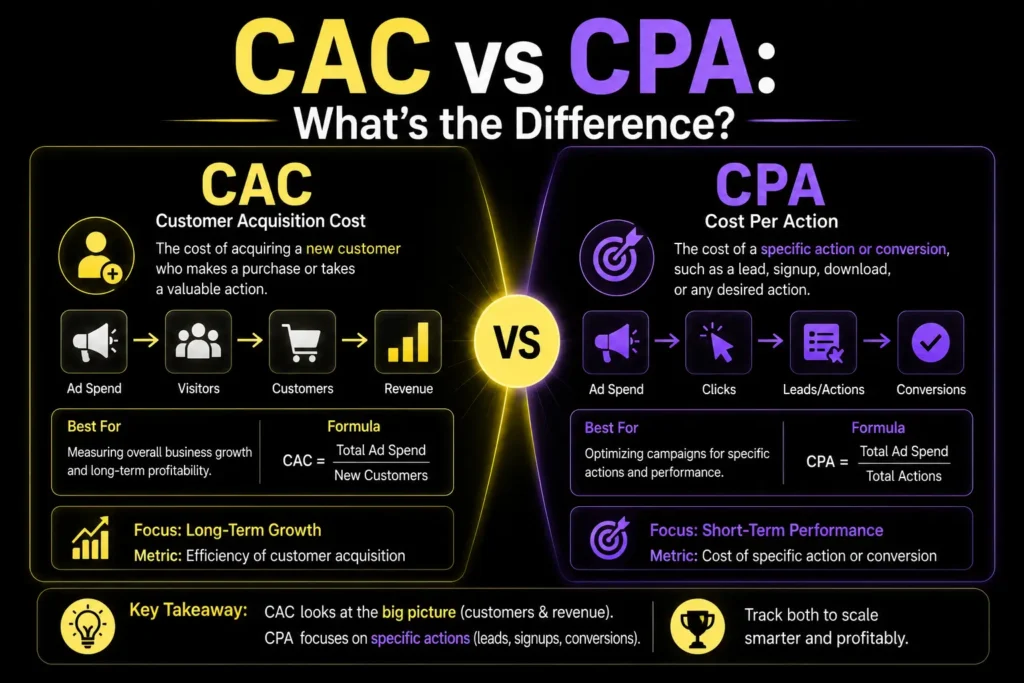
CPA stands for Cost Per Acquisition – how much you spend to achieve that single specific conversion. That conversion could be a lead, app install, signup, or sale.
Unlike broader business metrics, CPA focuses on campaign-level performance. Therefore, marketers use it to optimize advertising efforts.
CPA Formula
CPA = Total Campaign Cost ÷ Number of Conversions
Example
Campaign Spend: $2,000
Sales Generated: 100
CPA = $2,000 ÷ 100 = $20
In this case, each conversion costs $20.
What Is CAC?
CPA (Customer acquisition cost) definition is the overall cost of getting a customer for your company. This refers to all your costs, not only conversion costs.
These costs may include:
- Advertising expenses
- Marketing salaries
- Sales team costs
- Software subscriptions
- Agency fees
- Content creation costs
Therefore, customer acquisition cost gives a complete picture of business profitability.
Customer Acquisition Cost Formula
Customer Acquisition Cost Formula = Total Sales and Marketing Expenses ÷ Number of New Customers
Example
If our company spent:
- Marketing: $25,000
- Sales: $15,000
- Total Expenses: $40,000
- New Customers Acquired: 200
Customer Acquisition Cost = $40,000 ÷ 200 = $200
Essentially, we were spending $200 for each customer!
CAC vs CPA: Key Differences
Let’s compare the two directly to understand the differences between CAC and CPA better.
| Feature | CPA | CAC |
| Measures | Cost per conversion | Cost per paying customer |
| Includes | Campaign spend | Total sales and marketing expenses |
| Used By | Performance marketers | Business leaders and marketers |
| Purpose | Campaign optimization | Profitability measurement |
| Scope | Individual campaigns | Overall business acquisition cost |
Although both metrics involve acquisition costs, they answer different business questions.
When Should You Use CPA?
CPA is useful while optimizing the campaigns and campaign manager use CPA to understand how to earn conversions in lowest cost possible by different campaigns
You should monitor CPA when:
Running paid search campaigns
Testing new creatives
Comparing advertising platforms
Scaling winning campaigns
For example, businesses investing in Google Ads for D2C brands often rely on CPA to improve campaign efficiency before increasing budgets.
When Should You Use Customer Acquisition Cost?
Use customer acquisition cost when evaluating long-term business growth.
CAC helps you:
Measure marketing efficiency
Forecast growth
Set realistic budgets
Improve customer profitability
Compare acquisition channels
Moreover, investors frequently review CAC before funding growing businesses.
Why CAC vs CPA Matters
Most marketers celebrate a low CPA, which usually seems to mean that the company is operating at a profit.
For instance:
CPA: $18
Customer Acquisition Cost: $160
The campaign appears successful. However, total acquisition expenses remain high after adding salaries, software, and sales costs.
Therefore, businesses should monitor both metrics together.
How to Reduce Customer Acquisition Cost
The reduction in customer acquisition cost requires ongoing optimization.
Here are proven strategies:
Improve Conversion Rates
Better converting ads mean lower acquisition costs for the same amount you spend on advertising.
Target Better Audiences
The efficiency gains from audience optimization can lead to the optimization of your advertising dollar spent.
Optimize Landing Pages
Fast loading and user-friendly landing pages actually help to improve the conversion performance of the landing page.
Increase Customer Lifetime Value
Having a base of customers that repeatedly buy from us works really well for us, as this money can help finance the acquisition of new customers.
Partner With Experts
If the campaign could be performed much better by a professional and efficient e-commerce marketing agency, you would not waste your hard-earned money at all.
Common Mistakes When Comparing CAC vs CPA
Many businesses make avoidable mistakes.
These include:
Using CPA as the only success metric
Ignoring sales team expenses
Excluding software subscriptions
Forgetting retention costs
Calculating CAC inconsistently
Instead, review both metrics regularly. Consequently, your marketing decisions become more accurate.
Final Thoughts on CAC vs CPA
Understanding CAC vs CPA helps businesses measure both campaign success and overall profitability. CPA improves advertising performance, while customer acquisition cost reveals the true expense of acquiring customers.
Use the customer acquisition cost formula every time. Then compare with CPA for your entire marketing view. Businesses that use the CAC vs CPA formula are able to control spend, drive revenue growth, and increase profit margins.
FAQs
1. Is CAC the same as CPA?
No. CPA measures the cost of a campaign conversion, while customer acquisition cost includes all sales and marketing expenses required to acquire one customer.
2. What is the customer acquisition cost formula?
Customer Acquisition Cost Formula = Total Sales and Marketing Expenses ÷ Number of New Customers.
3. CAC or CPA Which metric do you value most?
Both are valuable. CPA helps optimize advertising campaigns, whereas customer acquisition cost measures overall business profitability.
4. Can a business have a low CPA but a high CAC?
Yes. Advertising might convert great, but sales, other costs, and operations can boost your customer acquisition cost dramatically.
5. How often should businesses calculate CAC?
Companies generally assess CAC on a month to month basis or a fiscal quarter basis in an effort to keep tabs on how productive the campaigns actually were for financial and planning budgets.