Hitting $50k/month is a big milestone. However, scaling beyond that is where things get challenging.
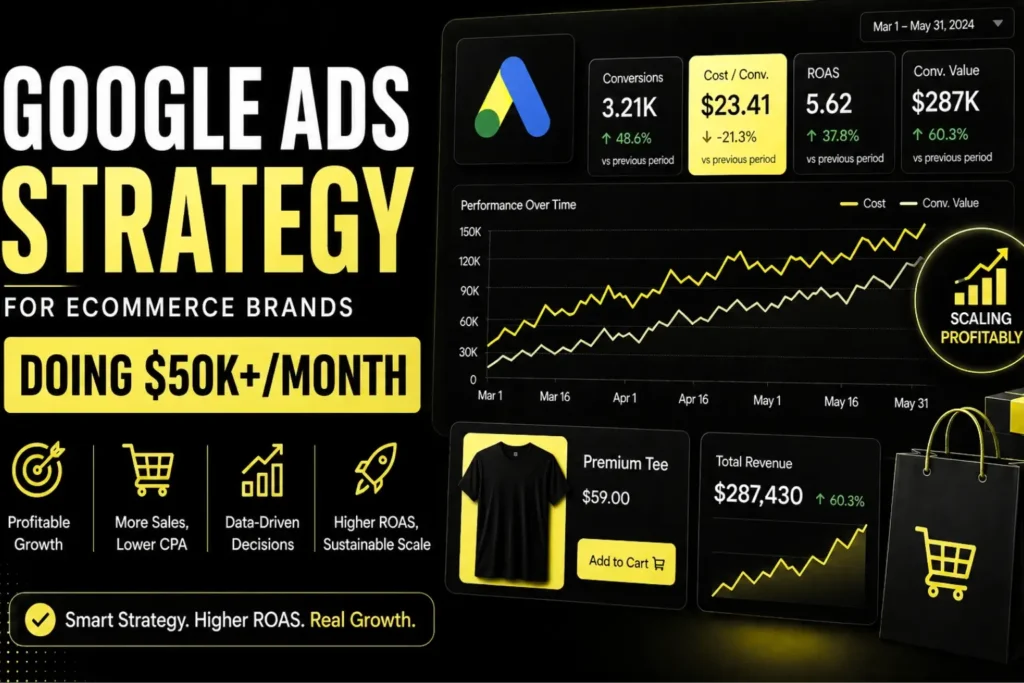
Because at this level, every decision affects your profit. So, you can’t rely on basic tactics anymore. Instead, you need a smarter Google Ads Strategy for e-commerce that focuses on efficiency and growth.
Let’s break it down.
Why Scaling Google Ads Gets Hard After $50k/Month
At lower budgets, small mistakes don’t hurt much. But as you scale, those same mistakes become expensive.
For example, many brands:
- Increase budgets too fast
- Target broad keywords
- Ignore campaign structure
As a result, costs go up. However, performance doesn’t. So, the goal is not just more traffic. Instead, it’s profitable growth.
What a Winning Google Ads Strategy for Ecommerce Looks Like
Strategy 1: Build a Strong Campaign Structure
First, fix your structure.
Because without a solid setup, scaling becomes messy.
You should:
- Split campaigns by product category
- Separate top-performing products
- Control budgets carefully
This is where a Google Ads structure for D2C brands spending $50k+ becomes important.
As a result, your data becomes clearer. So, your decisions improve.
Strategy 2: Focus on High-Intent Traffic
Next, focus on the right audience. More traffic sounds good. However, it often wastes money.
Instead, target users who are ready to buy.
For example:
- Product-specific searches
- Long-tail keywords
- Purchase-driven queries
Also, use negative keywords. Because they block irrelevant clicks, your campaigns become more efficient.
Strategy 3: Use Shopping Ads to Drive Sales
Now, let’s talk about Shopping ads.
These ads show:
- Product images
- Prices
- Store details
So, users already know what they’re clicking on. As a result, conversion rates are higher.
Strategy 4: Optimize Your Product Feed
Shopping ads only work if your feed is strong. So, focus on:
- Clear product titles
- Accurate pricing
- High-quality images
Since Google relies on this information, improved inputs will yield improved outputs.
Strategy 5: Use Smart Bidding to Scale
At first, manual bidding works fine. However, as you grow, it becomes limiting.
So, switch to smart bidding.
It uses signals like:
- Device
- Location
- User behavior
As a result, bids adjust automatically. But remember, this only works with proper tracking.
That’s why many brands choose a Google Ads agency for ecommerce to handle advanced setup.
Strategy 6: Use Remarketing to Recover Sales
Not every visitor buys immediately.
In fact, most don’t. So, you need remarketing.
You can target users who:
- Visited your site
- Viewed products
- Added items to cart
Because of this, you bring them back and increase conversions.
Strategy 7: Scale Budget Carefully
Finally, scale the right way. Many brands increase budgets too quickly. However, this often reduces ROAS.
Instead:
- Improve performance first
- Stabilize campaigns
- Increase budget slowly
At the same time, track:
- ROAS
- CPA
- Conversion rate
Read here in detail about scaling ecommerce Google ads the right way.
Common Mistakes to Avoid
Even the most established brands are prone to errors. Partnering with a good ecommerce Google ads agency can help you avoid them successfully.
Here’s what to avoid:
- Structure
- Overly wide targeting
- Unoptimized product feed
- Remarketing
- Tracking
Addressing these problems will immediately boost your results.
Final Thoughts
Expanding above the $50k/month mark necessitates an altogether different strategy. At this point, you cannot afford to make any guesses.
The following factors become crucial:
- Good structure
- Intent-based targeting
- Efficient bidding
- Constant optimization
Why? Because when all these elements combine, your Google Ads Strategy for Ecommerce becomes consistent and scalable.
FAQs
1. What is a good conversion rate?
Usually, 3-5% is good. However, top brands often achieve higher rates.
2. How do I scale without losing profit?
First, improve efficiency. Then, increase budgets gradually.
3. Are Shopping ads necessary?
Yes. Because they bring high-intent traffic and better conversions.