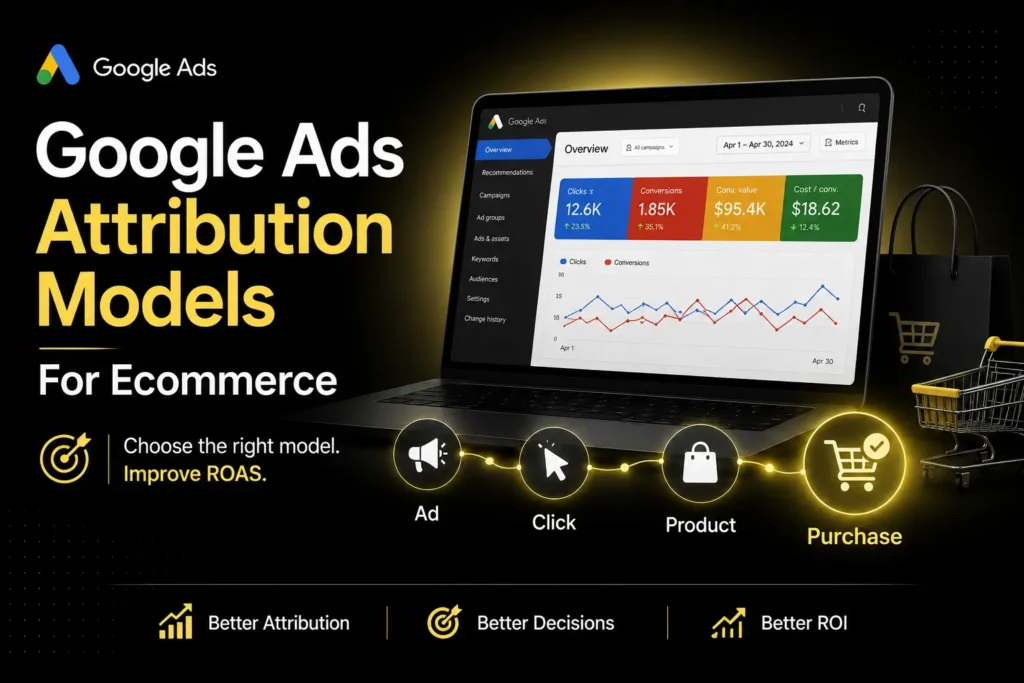
Getting the attribution model Google Ads right matters for every eCommerce business. Shoppers rarely buy after one click. They see a few ads, compare products, leave, and come back before they actually purchase. So the Google Ads attribution model you use decides which campaigns get credit for that sale – and which ones get your next dollar of budget.
Good attribution also improves how you bid, how you optimize campaigns and in the end your return on ad spend (ROAS). Once you realize how eCommerce attribution models work all of these decisions suddenly make much more sense.
What Is an Attribution Model Google Ads?
Attribution model Google Ads is how a marketer decides which touchpoints are rewarded for the conversion when a potential customer visits multiple times prior to purchase.
A typical path might look like this:
- Click a Shopping Ad.
- Come back later through a Search Ad.
- Watch a YouTube ad.
- Buy after clicking a branded search ad.
Attribution looks at all four of those steps instead of handing all the credit to the last click. That gives you a real picture of what actually moved the customer to buy.
Why Attribution Matters For ECommerce
Your average customer interacts several times before making a purchase. Focus only on the click of their purchase and you’ll be underscoring many of the campaigns that led up to the purchase.
Using the right Attribution model in Google Ads helps you:
- Put the budget where it actually works.
- Spot your best-performing campaigns.
- Make smarter bidding calls.
- Push ROAS higher.
- Understand how customers actually behave.
Google Ads Attribution Models Explained
Over the years, Google Ads has evolved so much and the same goes for eCommerce attribution models integrated into it. Data Driven Attribution (DDA) is now Google’s recommended Google Ads attribution model – it uses machine learning to work out how each interaction contributed to a conversion.
The older rule-based models – First Click, Linear, Time Decay, Position-Based – have mostly been phased out for new conversion actions. But they are still relevant to understand for someone working in older reports anyway.
Data-Driven Attribution
Data-Driven Attribution will review the actual conversions and apply a credit distribution strategy, not simply use a pre-defined approach.
It weighs things like:
- Device type
- The customer’s path to purchase
- Time between clicks
- Which campaigns were involved
- Patterns across conversions
For a growing eCommerce business, this is the model that gives you the clearest read on what’s working.
Last Click Attribution
Last Click hands all the credit to the final ad someone clicked before buying.
It’s the easiest entry to reading but takes nothing away that had happened earlier in the trip.
Google Ads Conversion Tracking and Attribution
None of this works without solid Google Ads conversion tracking underneath it.
Make sure you’re tracking:
- Purchases
- Add-to-cart events
- Checkout completion
- Lead form submissions
- Newsletter sign-ups
Pair up your Google Ads too in GA4 too. Show Google Ads what ads are going on; fill it all in via GA4 to give an end-to-end journey.
Best Practices for Better Attribution
- Use Data-Driven Attribution wherever you can.
- Check your attribution reports monthly.
- Track every conversion action that matters to the business.
- Don’t set budgets based on Last Click alone.
- Look at Performance Max, Shopping, Search, and Remarketing together, not in isolation.
- Keep Consent Mode and first-party data collection set up properly, so measurement holds up without stepping on user privacy.
Common Attribution Mistakes to Avoid
A lot of advertisers hurt their own results by:
- Leaning on Last Click reporting alone.
- Ignoring upper-funnel campaigns.
- Running incomplete conversion tracking.
- Comparing GA4 and Google Ads numbers without accounting for how differently they attribute conversions.
- Letting attribution reports go unchecked for months.
Fix these and your optimization gets sharper almost immediately.
Strengthen Your Google Ads Strategy
However, attributed conversions only tell part of the story. An effective strategy for a Google Ads strategy for eCommerce brands also covers targeting, product optimization, bid strategy, and the elements you should track when it’s time to optimize and test.
Plenty of growing brands bring in an experienced ecommerce ad agency to sharpen campaign performance, cut wasted spend, and scale the campaigns that are already working – using attribution data to back those decisions.
Conclusion
Picking the right attribution model Google Ads gives eCommerce businesses a real understanding of how customers convert across multiple touchpoints. Data-Driven Attribution is Google’s recommended approach now because it simply beats the old rule-based models on accuracy.
Add that into really good Google Ads conversion tracking and GA4 reporting, and there is a good foundation for budget intelligently and expand this over time.
FAQs
1. What is the best attribution model Google Ads for eCommerce?
I use data-driven attribution models as they employ machine learning algorithms and provide the opportunity for advertisers to credit their customers’ decision paths accordingly.
2. Why is Google Ads conversion tracking important?
Because it’s what makes your attribution reports trustworthy in the first place – you can’t credit conversions accurately if you’re not tracking them accurately.
3. Should I use Google Ads and GA4 together?
Yes – Google Ads reports how your ads are doing, while GA4 fills out the journey view of the customer.
4. Is Last Click Attribution still useful?
It’s okay for a fast-track to an easily digestible answer, but it overlooks the early interactions that are really closing the deal. Data-Driven Attribution offers a deeper insight for eCommerce companies.