Good product. Solid offer. Ad that actually hits the mark. And there’s still one thing that can wreck the whole setup.
What happens after someone clicks?
Land that clicks on a cluttered homepage, or one that has nothing to do with what the ad said, and the sale’s gone. Often before the shopper even sees your product.
That gap is exactly what landing pages for eCommerce are for.
Show visitors what they expected, make the next move obvious, and click to purchase stops being a guessing game.
What Are Landing Pages For E-commerce?
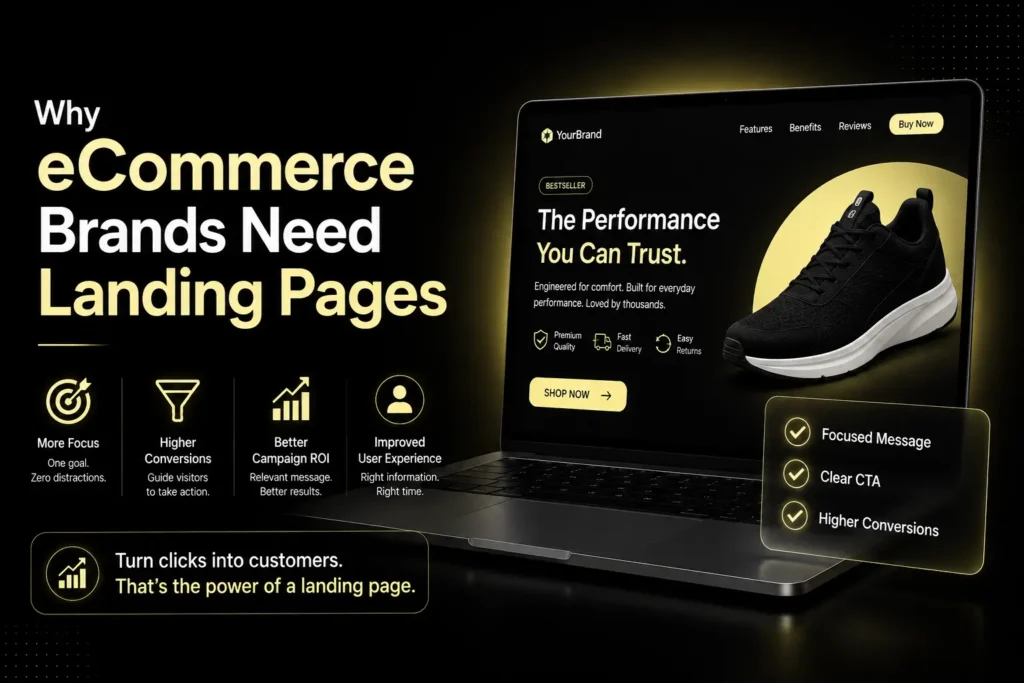
An ecommerce landing page has one job: push visitors toward a specific action. Buying, checking out an offer, signing up, whatever fits.
It’s not your homepage. No need to explain the whole business here, just one audience, one offer, one primary action.
Running a Google ad for 20% off running shoes? Sending that click to a generic homepage adds friction nobody wants. The designated landing page features all the shoes, the discount information, the perks of using them, as well as the “Shop Now” button – everything in one place without any need for extra searches.
Google defines the landing page experience by the usefulness, relevance, ease of navigation and the ability to deliver on its promise stated in the ad.
Why Do E-commerce Brands Need Landing Pages?
1. They connect the ad to the offer
The ad makes a promise. The landing page keeps it. That’s how it works.
Google suggests using landing pages that are close matches for your ads and keywords with the CTA being consistent on both. Simple journey, laid out plainly:
Search – Ad – Landing Page – Product – Purchase
Every disconnect along that path costs you a shopper.
2. They reduce distractions
A homepage is loaded, links everywhere, categories, promos, all competing for the same five seconds of attention.
Fine when someone’s just browsing. Terrible when someone’s already decided they want to buy something specific.
A focused landing page cuts through that. Product front and center, nothing else fighting for attention. Matters even more with paid traffic, since every click there costs actual money.
3. They can improve the buying experience
Nobody buys without questions first. Right size, right fit? What’s shipping cost? Return policy? What actually makes this one worth it?
Your landing page has to answer that fast, or the visitor’s gone.
Baymard’s research found 64% of users actively look for shipping information on product pages. Yet 43% of sites just don’t put it there.
Good landing page design for eCommerce was never about looking slick. It’s about killing the doubts before they kill the sale.
How Do Landing Pages Help Google Ads Campaigns?
Google Ads landing pages matter much once people have clicked on it.
There are three main components that form the Google Quality Score – expected click-through rate, ad relevance and landing page experience. The click is not the end of the journey.
A person types “Women’s waterproof hiking shoes,” the ad is spot-on but the landing page offers completely unrelated shoes. This discrepancy comes with a price tag.
Take them somewhere relevant to their search. It is just that easy – offer more of what they’ve clicked on.
Once things get more complex, a Google Ads Agency for E-commerce Brands can pull your ads, landing pages, and conversion strategy into something that actually works as one system.
Which Elements Should Be Used In A Highly Converting eCommerce Landing Page?
No rocket science is required here. All you need is:
- Headline matching the visitors’ intention
- Strong product images that will show what the visitors are purchasing
- Benefits and key features in plain language
- One clear primary CTA
- Shipping and return information
- Reviews or other trust signals
- A mobile-friendly layout
- Fast page loading
Mobile speed gets its own mention here, deliberately. Google reports that in retail, a one-second delay on mobile can cost up to 20% in conversions.
That’s not some technical footnote. That’s a conversion strategy, plain and simple.
Product Landing Pages vs Standard Product Pages
A product landing page and a regular product page might look almost the same on the surface. Underneath, the goal’s different.
A standard product page sits inside the normal shopping flow: images, variants, details, buy button, done. A landing page usually gets built for one campaign, one audience, one keyword, one offer.
Might make sense to build separate landing pages for:
- A seasonal promotion
- A specific Google Ads campaign
- A best-selling product
- A particular customer segment
- A bundle or special offer
That way the message actually fits whoever’s arriving.
Product pages still matter, though, a lot. Baymard’s research shows nearly every user passes through a product page before buying. Central to the whole decision, basically.
Final Thoughts
The ad earns the click. The landing page earns the sale.
That is precisely why it makes sense to allocate dedicated landing pages for eCommerce efforts some attention in the growth strategy rather than treat them as an afterthought. Design relevant, useful, quick-loading, mobile-responsive, single-purpose pages that will clearly show users what actions to take next.
Same logic carries into your Google Ads Management For Shopify Stores strategy. Every click deserves somewhere real to land.
FAQs
1. Are landing pages necessary for ecommerce?
Not every page needs to be one. But dedicated landing pages earn their spot fast when campaigns are paid or offers are specific.
2. Should Google Ads send traffic to product pages?
Sometimes. Comes down to search intent and the campaign itself. What matters most: the destination actually matches the ad, keyword, offer, and CTA.
3. What makes a good ecommerce landing page?
E-commerce landing page checklist: Relevant, clear, fast, mobile-responsive, single-purpose with sufficient information to be confident about making the purchase.